|

Rarotonga is the largest of the 15 islands
that make up the Cook Islands archipelago. Believed to be
settled by the Polynesians in 1000 AD, the Cook Islands have a
population of 15,000. About 160,000 visitors per year (mainly
from New Zealand) come for the attractions of snorkeling, scuba
diving, cycling, hiking, deep sea-fishing and dining out.
|
|

The volcanic island stands 15000 feet
above the ocean floor. Its
densely forested interior slopes down to a fringe reef inside of
which lies a coral lagoon.
|

Avarua, the capital and commercial center,
has a small harbour and the main services for the island. |
|

Rarotonga is 32 km.
in circumference. A main road, Ara Tapu, circles the island.
There are two buses, one going in a clockwise direction, and one
anti-clockwise.
|

Historical
tribal land divisions (vaka) ruled by Ariki continue to
influence local decisions. |
|

Missionaries
brought Christianity to the island in 1823 and uprooted
traditional culture. The Takamoa Theological College,
established in 1839, has 20 branches throughout the Pacific. |
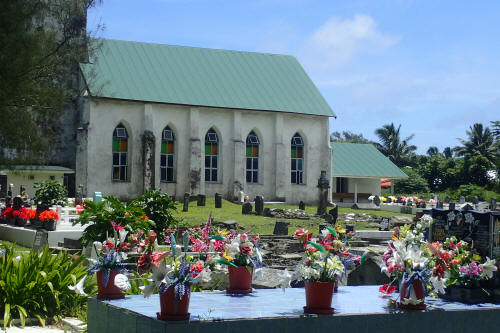
Cook Islanders
are devout Christians with strong church and family values.
Historical churches and cemeteries dot the island, and it is
common to see burial plots in families' yards.
|
|

We were welcomed to Cook Island Christian
Church services where there were glorious Maori hymns sung a
capella and generous banquet lunches. |

The Cook
Islands is a parliamentary democracy in free association with
New Zealand. 80,000 Cook Islanders live in New Zealand and
Australia.
|
|

Te Vara Nui is
a reconstruction of a traditional village offering cultural
tours, an overwater dance performance and a buffet dinner.
|

It is customary
to wear 'ei katu. These floral head pieces are even part of
school uniforms. |
|

Muri Beach lies where the lagoon is widest and sandiest. Four
small coral islets lie a short distance offshore within the
fringing reef. This is a popular tourist area for kayaking,
snorkelling, and glass-bottom boat cruising. |

While we were
there, a cyclone went through leaving damage and debris. Boats
were moved out of the harbour and schools and businesses were
closed. The whole community mobilized to clean up the next day.
|

At the Saturday Punanga Nui Market,
artists, craftspeople, a farmers' market and food kiosks provide
a glimpse of island life. |

The National Museum, the Cook Island
Museum and Library and the Pa Ariki Palace display books and
artifacts about Polynesian history.
|
|

Legends of the sea god, Tangaroa,
are among the rich
Cook Islands mythology.
|

Traditional practices are maintained such as the
hair-cutting ceremony. |

Youth are encouraged to maintain Maori language and
culture.
|
|

Our accommodation was at Lagoon Breeze
Villas, with a lovely garden, pool and access to the marine
reserve lagoon across the street.
|

We were afforded magnificent views of the
sunset over the lagoon. |

Coral reef life is abundant and colorful,
with many types of coral, sea cucumbers, turtles and giant
clams.
|

Species include triggerfish, butterflyfish, wrasses,
eels, parrotfish and blue starfish. |

New Zealand currency is widely used in the
Cook Islands; although, they also have their own coins and
bills, including a 3-dollar bill, and a triangular 2-dollar
coin. |

Typical local island food includes ika
mata (raw seafood salad in coconut), umu (roasted
pork and chicken), rukau (cooked taro leaves),
passionfruit, papaya or mango salad, fried plantain,
cassava or taro root, and desserts of banana poke pudding and
pineapple pie. |